

Explain Plato’s account of democracy
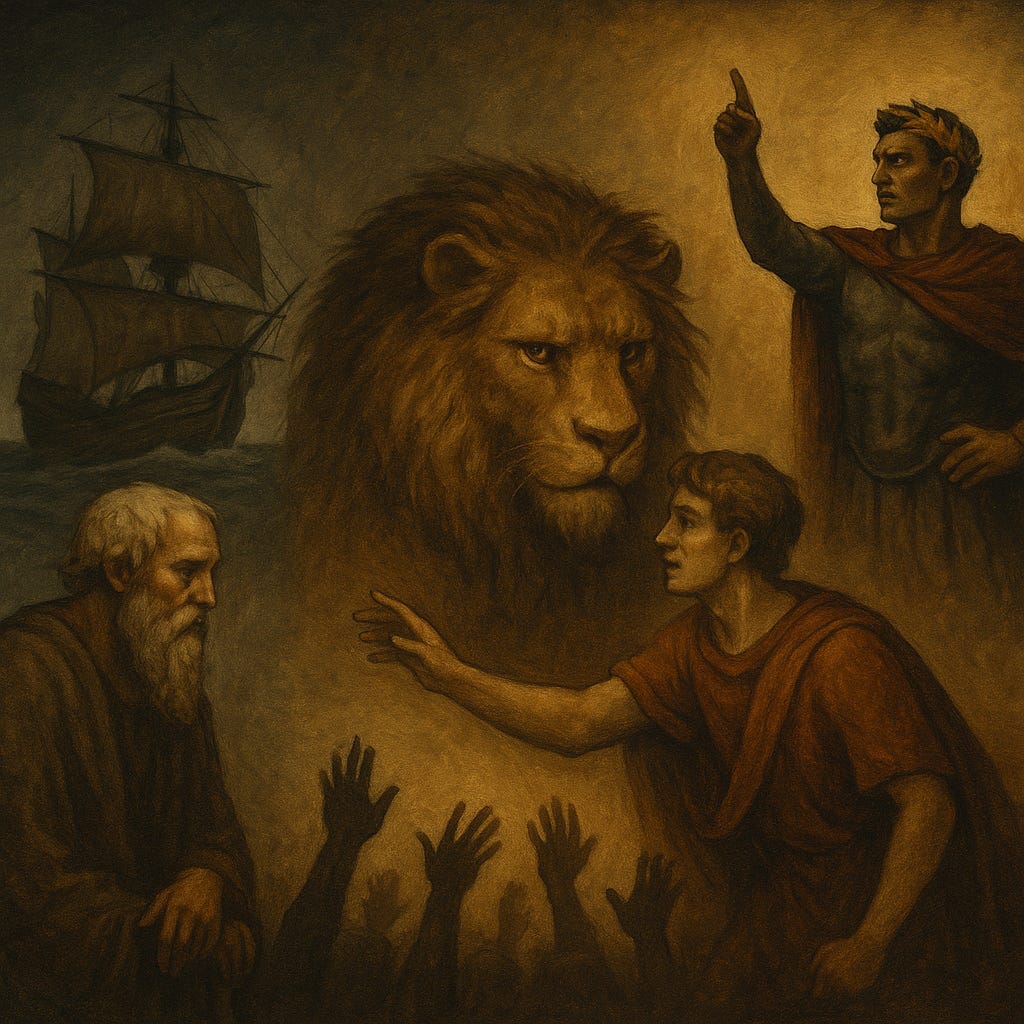
We may parse Plato’s account of democracy in The Republic into three passages thereon: the simile of the ship; the simile of the beast; as a stage in the degeneration of the just city. Let us consider each of them in turn.
It must be remembered that in Plato’s just city, the state regulates every aspect of its citizens lives, and is thus split into three classes. The ruling class is made up of philosophers, specially trained to ensure order and justice.
This in mind, the simile of the ship is a criticism of the democratic mode of government centred around the way in which philosophers are marginalised.
He analogises the state to a ship: the captain represents the citizens, “larger and stronger than any of the crew, but a bit deaf and short-sighted”; the crew are the politicians, each vying to captain the ship; the true art of navigation is knowledge of the form of the good that is needed to rule properly; and the philosopher is the true navigator.
Plato in this way shows that democracy is flawed as the people will get a ruler who is in no way qualified to run the ship, and the philosopher is not taken seriously; this partly accounts for why the philosopher is often seen as useless. The people are […] here; they should be asking the most qualified candidate to rule them in the name of the good, but instead, the ruler seeks the permission of the people to rule them – he “begs them to accept direction”.
The simile of the beast goes further than explaining who philosophers, who Plato claims should rule, are marginalised and useless: it shows how they become contemptible, as their philosophical potential is corrupted.
Here, the beast represents the people of a democracy, and politicians are beast-tamers – all of whom used to have the potential to become a philosopher. The stylistic flair, political persuasion, and control of the people that a democratic politician must have to win over the people is the skill of animal-taming, the […] of which is like the sophists, who learn political manipulation and corrupt philosophical potential.
This shows that democracies have incentive structures in all the wrong places. Since rulers are not appointed but elected at the will of a manipulable citizenry, potential philosophers become all style and no substance, in order gain power. Here, the people – the beast – get the leaders they deserve.
The final way in which Plato refers at length to democracy is as the final stage before tyranny in the collapse of the just city. When the just city loses the virtue of wisdom, it becomes a timocracy (military rule); it then loses its courage and becomes an oligarchy (rule of the [rich] few).
At this stage, the rich ‘sons’ squander their wealth so much that the wealth becomes more and more concentrated in the hands of the very few with the self-discipline to hold onto it. Then the poor become increasingly resentful and conscious of their political power; they rebel and overthrow the oligarchs, bringing about the democratic state.
This is full of freedom for its individuals to do and say as they desire, live whatever life they choose – there is no obligation to exercise civic responsibility.
It is, in short, the loss of the self-discipline that ruled the oligarchy, that was needed to earn and keep money. Plato thinks that “you’d expect it to be an enjoyable kind of regime … anarchic, colourful, and growing equality of a sort to equals and unequals alike.” Apparently laws can be broken with no consequence; and the people jump from whim to whim, jumping between careers and activities.
The democracy is, therefore, a precursor to tyranny, as the unserious and undisciplined citizens elect their captain, their beast tamer who pays them lip service and charms them, but is not fit to rule.
These three passages account for Plato’s conception of democracy.
Assess Plato’s account of democracy
a) Assess Plato’s account of democracy (12/15)
Plato’s argument against direct democracy may begin with a recapitulation of the similes of the ship and the beast. These, he tells us, mean that those who are fit to rule – philosophers, with knowledge of the good – are marginalised, useless, and corrupted. In their instead, the ‘dead fand short-sighted’ people will elect to be ruled by those who beguile them with the skills of rhetoric and persuasion they were taught by the sophists.
We may take issue with many facets of his case. First, the obvious assumption undergirding them is that philosophers would make good rulers, and this need not necessarily be true. Second, he insists with the simile of the ship that democracy is a perversion of the natural order; however, we now hold that democratic liberty is a natural right: of course, we say in the 21st century, we the people ought to have a say in who we are ruled by. We can criticise his contention that the citizenry are so ignorant and easily fooled. We live, after all, in a world with better education and access to information than any other time; and furthermore, we have seen several instances in recent times of peoples acting against the will of their political masters – such as the Brexit vote in the UK in 2016.
It must be conceded that if it is the case that philosopher-rulers are the perfect ruler, then our democracies are flawed inasmuch as we miss out on their rule. However, Plato himself does not think that the just city can be realized; therefore, the democracy, where anyone can turn their mind to anything, is the only state in which the philosopher is free to philosophise. Moreover, it is not self-evident that one with knowledge of the good could not assimilate himself or herself into the political order, and be charming and charismatic without seeking to deceive; or to frame it another way, we should not give in to the temptation of cynicism that all politicians are self-interested and stupid. As to the question of whether the people of a democracy are so stupid as to be unable to see past the superficial veneer put forth by the politicians in public, while it is true that we are now more informed and better educated than ever, this is only in comparison to the low bar set by history. Political ignorance is pervasive because of the complexity of all involved variables in the political framework, and it can be near-impossible to follow some issues at a high level – we are therefore susceptible to rhetoric and sophistry.
In the aggregate, we may give Plato the benefit of the doubt here, in his arguments against direct democracy because it marginalises philosophers and gives a voice to the ignorant.
Let us then proceed onto a short point concerning Plato’s own steadfastness on his conception. Namely, the simile of the beast seems to imply that the people get what they deserve, unlike the simile of the ship.
It seems that Plato is confused or undecided as to whether the people of a democracy are victims or whether they are the problem. These conflicting accounts introduces a vagueness that suggests that he does not want to wrestle with the outline outcome of this dilemma, whatever it may be.
However, this point fades into irrelevance compared with the following point on Plato’s account of democracy as one of the stages of the decline of the just city.
Reason, courage, and self-discipline, Plato tells us, are gone. They are usurped by desire, and nay objective analysis of the best course of action for the just city is sacrificed for the subjective satisfaction of material desires.
He seems to paint a picture of democracy as anarchy – indeed, as we shall come to see, we will criticise him for conflating the two, and this mistake will prove fatal to him.
The fundamental point that Plato misses is this: there is a distinction between democratic cities as we see them now wherein the freedom we so desire, which Plato would criticise us for putting on a pedestal, is conceptualised as freedom being liberty. It is subject to the ‘liberty principle’, which tell sus that the individual is free to act as he or she pleases, up until the point that the exercise of freedom impinges on others’ freedom. Plato fails to provide an account of democratic pluralism, instead caricaturing direct democracy by accusing it of being full of freedom that is license: the individual does whatever he or she wants, explicitly, with no consequence.
Thus, for this reason, Plato’s account of democracy has in the following several centuries, been built upon, such that it is now totally flawed.
Result
Mark: 19/25
Feedback:
· Part a): 7/10
o A bit rambling – i.e., might be much more pragmatically focused on key points, but on the whole most of the key points are included.
· Part b): 12/15
o A v. coherent and interesting discussion, though because you are “somewhat prolix” the final + v. important point is cut short when it ought to be developed – and the separation of powers point is [… subdued?] which is v. important too.