
How, according to Nietzsche, did the bad conscience develop? Is his account philosophically plausible?
Submitted for PH334 (Nietzsche in Context) Coursework, 2200 words

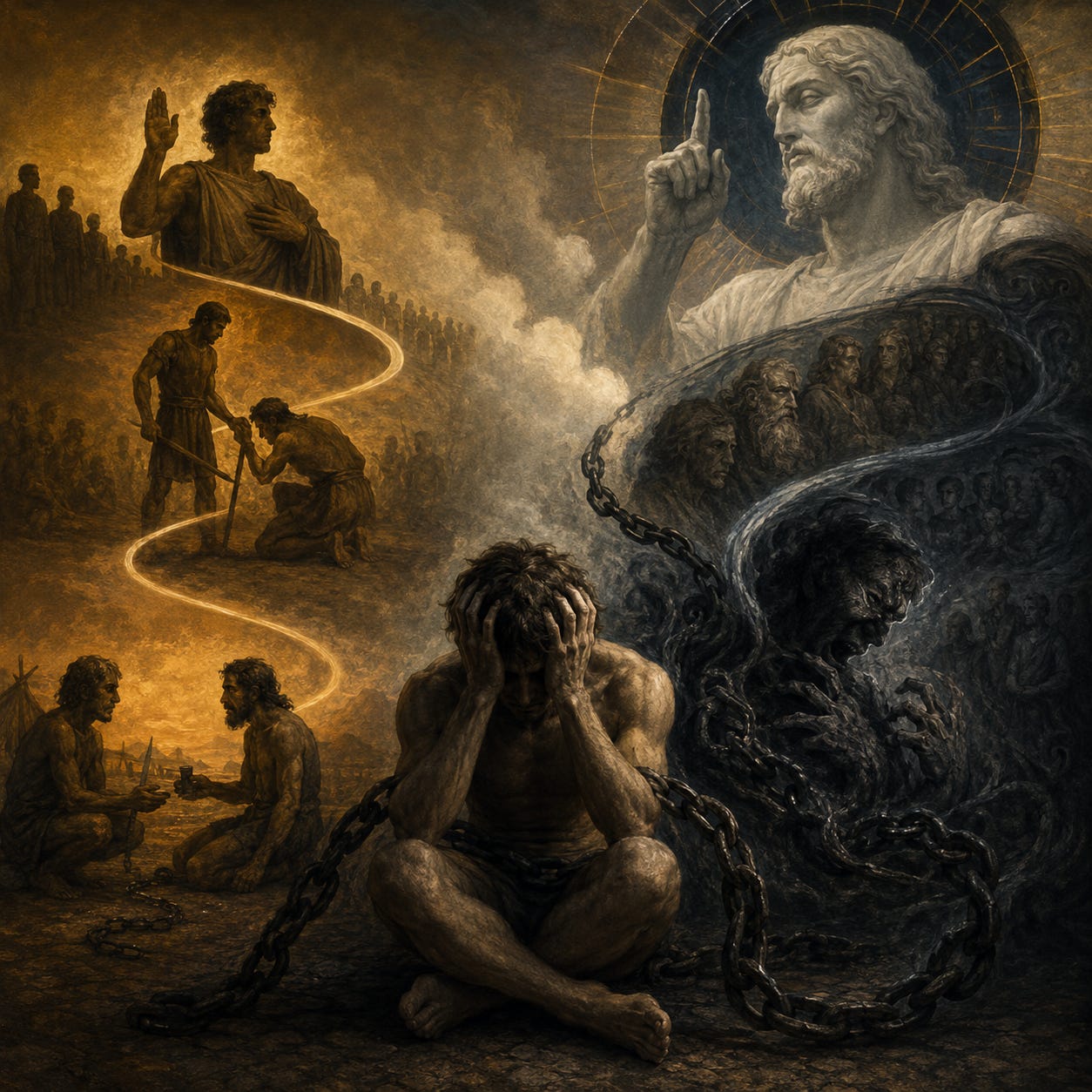
In the Second Essay of the Genealogy of Morals, Nietzsche inquires after the origin of “bad conscience” – not ordinary remorse, but the condition whereby persons make themselves suffer, interpret that suffering as deserved, and experience guilt as a standing verdict on themselves. I read his account as having four layers. First, humans acquire conscience by becoming capable of making promises and assuming responsibility. Second, obligation is organised through the creditor–debtor relation, which supplies a pre-moral grammar of guilt. Third, under socialisation, outward aggression is turned inward, producing non-moralised self-torment. Finally, this inward suffering is moralised through the extension of indebtedness to ancestors and then to God, becoming existential guilt. I argue that this final stage requires not the Christian God specifically, but a transcendent, condemnatory reference point: an anti-natural ideal before which the self’s whole existence appears deficient. So read, Nietzsche’s account is philosophically plausible: it explains how guilt becomes guilt for being what one is, and why that structure of self-condemnation can outlive the theology that first gave it its most concentrated form.
Nietzsche dispenses with the obvious hypothesis, that human beings became guilty because they were punished for wrongdoing, on methodological grounds. He maintains that the origin of a practice and its later meaning are not the same thing: something that has come into existence can be “reinterpreted to new ends” and made to serve purposes unrelated to its original ones. Thus, the fact that punishment is now often interpreted as serving retribution, deterrence, rehabilitation, moral condemnation, and so on, does not mean that it originated for any of those purposes (GM II.12-13). Accordingly, one cannot assume that punishment produced guilt, or that bad conscience first arose from the experience of being punished.
One might criticise this as a licence for speculative storytelling. But the method has a clear negative use: by separating a practice’s origin from its later utility, Nietzsche prevents us from projecting guilt back into practices that did not presuppose it (Leiter, 2002, pp. 168-169). Moreover, Nietzsche advances a plausible positive argument for denying this hypothesis – that punishment often makes people cautious rather than remorseful: the punished person thinks “something has unexpectedly gone wrong,” not “I ought not to have done that” (GM II.14-15). Thus, Nietzsche’s claim – that we must begin with the origin of conscience before it becomes bad – is plausible.
This origin lies in the “paradoxical task” of breeding “an animal with the right to make promises” (GM II.1). Human beings are naturally forgetful, but promise-making requires a “memory of the will”: the capacity to hold oneself to a future commitment despite this, and so to become sufficiently regular and capable to answer for oneself. This capacity had to be bred into humans through custom, pain, and social regularisation. The result is the “sovereign individual”, whose “proud awareness” of responsibility has become instinct, and who calls this instinct his “conscience” (GM II.1-3).
One might object that this is irrelevant to bad conscience, since the “sovereign individual” is proud, not guilty. But as (Reginster, 2011, pp. 70-72) stresses, the right to make promises is status-conferring, because the sovereign individual derives esteem from the durability of the will; thus, failures of commitment can bear on his worth as a person (Ridley, 1998, p. 15). This makes Nietzsche’s account more plausible, since instead of deriving guilt from cruelty, he first supplies responsibility, standing, and self-evaluation as the preconditions for guilt.
Bad conscience is thus not the essence of conscience itself; it requires the redirection of this capacity for responsibility. Nietzsche locates this redirection in the creditor–debtor relation. He uses the etymological link between Schuld (guilt) and Schulden (debts) to argue that moral guilt has a pre-moral ancestry in owing. In primitive contractual relations, a debtor’s failure to repay authorises compensation; where no material equivalent is available, this liability may be discharged through suffering, so that the creditor receives compensation in the pleasure of making the debtor suffer (GM II.4-6). This links suffering to payment, making self-punishment appear deserved.
Taken crudely, this looks weak: an etymology cannot establish a psychology, and a primitive debtor would more likely fear default than regard himself as morally reprehensible. But Nietzsche’s argument is not that debt is already moral guilt; it is that debt provides the pre-moral grammar out of which guilt could later be formed. He can therefore concede that guilt, since it concerns a diminution of one’s worth as a person, cannot be reduced to fear of punishment (Reginster, 2021, pp. 139-40). Hence, the creditor–debtor relation supplies a conceptual ancestry for guilt without committing Nietzsche to the implausible thesis that primitive contractual life simply taught human beings to feel morally guilty.
Since debt explains liability but not self-condemnation, the next stage is Nietzsche’s “own hypothesis” about bad conscience proper. Once human beings are enclosed within “society and peace”, their aggressive instincts are blocked from external discharge, and turn inward. This “internalisation of man” produces an inner world deep enough to become an object of its own cruelty. Bad conscience, in this form, is thus the suffering of the human animal from itself: the instinct for freedom, blocked by social life, takes the self as its object and makes it into “resisting, persecuted, suffering” material.
Two objections may be raised. First, Nietzsche’s account “depends crucially on the premise that instinctual energy does not simply vanish: it must be continuously discharged somehow” (Leiter, 2002, p. 234), but this premise is suspect: frustrated hunger and thirst do not become self-torment, or “turn inward”, but simply go unmet. Second, even if the internalisation of aggression is plausible, it does not explain guilt. The fact that a drive is redirected against the self does not show why the resulting suffering should be interpreted as deserved, or why the self should regard itself as morally blameworthy.
The first objection is forceful against a crude hydraulic thesis about all instincts. However, Nietzsche only needs the narrower claim that frustrated aggression can seek displaced, even self-directed, outlets. Hunger and thirst may simply remain unsatisfied, but it is psychologically plausible that drives toward cruelty and domination seek substitute objects when their ordinary outward discharge is blocked. The second objection, however, should be conceded; this “internalisation thesis” still underdetermines guilt. As (Risse, 2001, pp. 58-59) argues, Nietzsche here presents us with a non-moralised, “older form” of bad conscience, genealogically prior to guilt, in which what is “bad” is the painfulness of inward cruelty rather than any verdict of moral fault. (Leiter, 2002, pp. 232-235) similarly distinguishes this “animal bad conscience” (GM III.20) from bad conscience proper. Internalisation explains how human beings become capable of self-torment, but not why self-torment comes to appear deserved. That requires the further thought that one is a “legitimate recipient of cruelty” (Janaway, 2007, pp. 136-137).
Nietzsche locates this final step – the moralisation of suffering – in the extension of the creditor–debtor relation first to ancestors, and then to God. He argues that communities come to understand themselves as indebted to the sacrifices of their forebears; as the community’s power grows, its ancestors are magnified, until they are finally transfigured into gods (GM II.19). With the Christian God, “the maximum god attained so far”, there arises the maximum feeling of indebtedness (GM II.20).
Here, the account may appear inconsistent: Nietzsche gives two seemingly rival explanations of guilt, one from internalisation, the other from debt to God. But as (Janaway, 2007, pp. 132-134) rightly argues, the two strands are complementary elements of a single synthesis. Internalised cruelty becomes guilt when it co-opts the creditor–debtor structure: inward suffering “borrows” the legitimating form of punishment, so that the self not only suffers, but takes itself to be the rightful object of suffering. Thus, divine debt is not automatically guilt; rather, debt is “pushed back” into bad conscience and becomes “an instrument of torture” (GM II.21). Hence, Christianity supplies an interpretation under which the whole self can become guilty: inward suffering is construed as deserved punishment before an infinite creditor.
Although Nietzsche does not present the genealogy so schematically, this four-stage reading preserves its plausibility by treating its aspects as cumulative. Promise-making explains responsibility without guilt; debt explains liability without inwardness; internalisation explains self-torment without desert; and divine indebtedness supplies the framework in which self-torment can appear deserved. This fits Nietzsche’s methodological claim that historical phenomena arise through successive reinterpretations rather than single origins (GM II.12).
On this reading, however, it seems that this account must depend on Christianity, which would render it both historically narrow and philosophically implausible. If guilt requires God, Nietzsche’s account becomes confined, as (Ridley, 2005, p. 35) objects, to “quite narrowly theocratic contexts”, rather than illuminating moral consciousness more generally. Accordingly, (Ridley, 2005, pp. 37-38) argues that guilt must already be available before Christianity: on his reconstruction, debt becomes guilt when the debtor interprets his indebtedness as freely incurred, thinks, “I ought not to have done that,” and takes his action “as such” to be reprehensible.
This account has two attractions. First, it captures an ordinary sense of guilt that (May, 1999, p. 77) calls “an experience of reprehensible failure”, making Nietzsche’s account more plausible insofar as it captures a broader psychological phenomenon than specifically religious guilt. Second, it fits Nietzsche’s claim that the man of bad conscience seizes on God as an instrument for making his own unworthiness certain, which suggests that the self-condemning tendency is already present before its theological intensification (GM II.22). Moreover, it explains why Nietzsche can imagine redirecting bad conscience against life-denying ideals themselves (GM II.24): guilt cannot always depend on explicit belief in God if it can be felt toward temptations to God, nature-denial, or the beyond.
(Risse, 2005, pp. 46-47) responds by distinguishing “locally-reactive guilt”, which he defines as a response to particular failures, from “existential guilt”, “a condition that shapes one’s whole existence”. Nietzsche’s target is the latter – in (GM II.21), he says that he has “deliberately ignored” the moralisation of debt and duty, which would be unnecessary if full guilt had already been explained by internalisation and debt. Ordinary debts are, in principle, payable; but when the creditor is the Christian God, indebtedness becomes structurally inexpiable. The result is not guilt for a particular deed, but guilt for being the kind of creature one is: the debtor wills himself “guilty and reprehensible to a degree that can never be atoned for” (GM II.22). So, if Nietzsche is explaining existential rather than local guilt, the final stage is necessary: only a standard before which one’s whole life appears deficient can explain guilt for being what one is.
If this is granted, the narrowness objection returns. Ridley worries that if belief in God is a condition of guilt, it becomes mysterious how guilt could survive the death of God. Since Nietzsche wants to explain how Christian valuations survive atheism, he must also explain “how the notion of guilt can survive the advent of atheism”. For Ridley, this is straightforward: guilt is a “logical condition rather than a logical consequence of belief in God”. But if God is a “conceptual prerequisite” of guilt, then “it is not at all obvious how the use of a concept might survive the removal of its own conditions of intelligibility” (Ridley, 2005, p. 42).
Risse replies that he is not explaining the “intelligibility of a concept”, but offering “a quasi-historical” account of how “a kind of moral psychology arose” (Risse, 2005, p. 48). Existential guilt may have arisen through the Christian God, and atheists – formed within a culture shaped by that inheritance – may have later inherited its phenomenology. So, Nietzsche’s account can remain plausible without losing its relevance to post-Christian morality: the death of God removes the explicit theological object, but not the psychic structure of self-condemnation formed under it.
This reply answers Ridley’s survival objection, but not the worry about narrowness. If the Christian God in particular is necessary for existential guilt to arise, Nietzsche’s account explains only how a distinctively Christian form of guilt can persist after belief weakens, not why structurally similar forms of self-condemnation might arise in non-Christian or only indirectly Christian contexts. Ridley is therefore wrong to remove God, or something like God, from the account altogether, but right that Nietzsche’s account is implausible if tied too narrowly to Christian theism.
This objection can be overcome by generalising Risse’s reading: existential guilt requires not the Christian God specifically, but a transcendent, condemnatory reference point before which the self’s whole existence appears deficient. Risse’s formulation allows this, since existential guilt “presupposes a reference point vis-à-vis which one’s life is so experienced”, and he concedes that “other explanations of existential guilt are possible” (Risse, 2005, p. 46). Nietzsche’s text also points beyond Christianity, connecting the moralisation of debt to “existence in general” being considered worthless, nihilistic withdrawal from life, and “Buddhism and the like” (GM II.21). Christianity is paradigmatic, because it is most salient in Nietzsche’s culture and because it most powerfully fuses creator, creditor, judge and redeemer; but the general structure is broader. The plausibility of Nietzsche’s diagnosis therefore does not depend on the ubiquity of Christianity, but on the availability of comparably absolute ideals.
However, this generalisation must be restricted. A transcendent reference point explains existential guilt only when natural human life is made answerable to a standard before which it must fail. Otherwise, any culture with gods or ancestors would produce bad conscience, making the account implausibly broad. Nietzsche’s Greek contrast shows why this is false. The Greeks had gods, shame, punishment, and explanations of wrongdoing, yet their gods helped prevent guilt from becoming existential: error could be interpreted as folly, delusion, or divine interference, and the gods “took upon themselves, not the punishment but, what is nobler, the guilt” (GM II.23). What Christianity adds is not transcendence alone, but an anti-natural ideal before which the self’s own instincts appear culpable. So read, Nietzsche’s account is plausible: bad conscience arises when the self is condemned not merely for what it has done, but for what it is.
Hence, bad conscience emerges through a series of reinterpretations: the responsible will makes self-evaluation possible; debt makes suffering intelligible as payment; internalisation supplies self-cruelty; and religion gives that cruelty an apparently justified object. The strongest objection is that this makes guilt too dependent on Christian theism. But that can be met by distinguishing Christianity’s historical role from the broader structure it exemplifies. Read this way, Nietzsche’s account is plausible insofar as bad conscience requires not God as such, but an anti-natural, condemnatory ideal before which the self becomes guilty for being what it is.
Bibliography
Janaway, C. (2007). Beyond Selflessness: Reading Nietzsche’s Genealogy. Oxford University Press.
Leiter, B. (2002). Nietzsche on Morality. London: Routledge.
May, S. (1999). Nietzsche’s Ethics and His War on “Morality”. Oxford: Oxford University Press.
Nietzsche, F. (1967). On the Genealogy of Morals. In F. Nietzsche, & W. Kaufmann (Ed.), On the Genealogy of Morals and Ecce Homo (W. Kaufmann, & R. J. Hollingdale, Trans., pp. 1-163). New York: Vintage Books.
Reginster, B. (2011). The Genealogy of Guilt. In S. May, On the Genealogy of Morality: A Critical Guide (pp. 56-77). Cambridge: Cambridge University Press.
Reginster, B. (2021). The Will to Nothingness: An Essay on Nietzsche’s On the Genealogy of Morality. Oxford University Press.
Ridley, A. (1998). Nietzsche’s Conscience: Six Character Studies from the Genealogy. Cornell University Press.
Ridley, A. (2005). Guilt Before God or God Before Guilt? Journal of Nietzsche Studies, 34-45. Retrieved from https://www.jstor.org/stable/20717850
Risse, M. (2001). The Second Treatise in On the Genealogy of Morality: Nietzsche on the Origin of the Bad Conscience. European Journal of Philosophy, 9(1), 55-81.
Risse, M. (2005). On God and Guilt: A Reply to Aaron Ridley. Penn State University Press. Retrieved from https://www.jstor.org/stable/20717851
Result
Mark: 78% (Lower Mid 1st)
Feedback:
This is a very good essay. Your reconstruction of Nietzsche’s narrative in GM II is careful, patient, and shows good knowledge of both the primary and secondary texts.
I think you are exactly right that Risse’s reading can be generalised, and the text you cite in support of this is probative. I am less certain whether you fully respond to the narrowness concern (at least in all its forms). One version of that concern, which you note, is that Nietzsche doesn’t give us an account of “locally-reactive guilt.” But the sort of generalisation of Risse’s account you have in mind seems to be to forms of “original sin” other than the Christian. That still seems to leave the objection unaddressed.
One further suggestion: instead of pausing your exposition to address objections as they arise, it might have been better here to get the interpretation on the table first, and then deal with the objections all together. This would make the paper read more naturally, but it is really just a stylistic point.