
How can we distinguish between knowledge, belief and opinion?
Submitted for IB Theory of Knowledge Exhibition (analysis of three real-world objects linked to a prescribed knowledge question), 950 words

Exhibition
My Bible
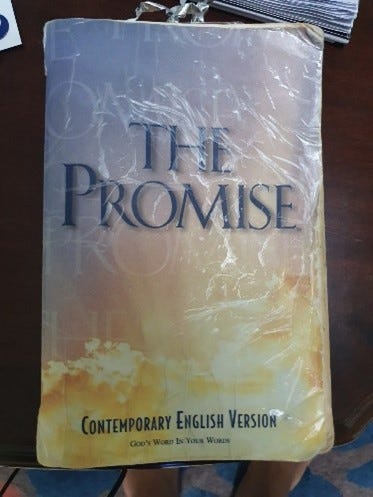
The first object I will consider is my Bible. It is an important text, both for Christians and non-believers alike: for the former, because it is the foundation of their worldview; for the latter, because of the ways it has shaped Western civilisation and our cultural and moral landscape.
It has been chosen as part of this exhibition because it provides an interesting example of a pervasive object from which knowers may lay claims to derive knowledge about morality, or how the world is; and which is linked to religious beliefs and opinions, and various facets thereof show how we can demonstrate these to be distinct categories.
It is obvious when we consider this that believers cannot know the veracity of the text in the way that they may claim to; indeed there are aspects of the Bible that believers know cannot be the case – elements which contradict modern science – and which contradict other parts of the Bible.
It points to an interesting feature of belief – its incorrigible link with faith. I propose that the key feature of faith, and therefore of belief, is that there is nothing that could empirically be shown to be the case that would, in principle, cause a believer to cease to have faith.
Put more concretely: I don’t believe in God. However, there are certain things that, if true, would cause me to reconsider – say, if people who blaspheme were conspicuously struck down, or if prayers were answered in a manner that was verifiable and repeatable.
This upholds a fact that we intuitively understand to be the case – that atheism is not a belief, but rather an opinion. However, as we have shown, for a firm Christian, even many flaws in the text that is the basis of belief will not cause a believer – someone with faith – to err.
Thus we have identified a core facet of belief that demonstrates that it is distinct from both knowledge and opinion.
My School’s Library

My second object is my school’s library.
Libraries are collections of books that can be borrowed temporarily. While we are accustomed to their ubiquity, we might consider why academic institutions like my school pay so much to have one.
This provides an interesting stepping-off point to discuss the role of belief and particularly opinion in the attainment of knowledge, making the distinctions clearer.
The benefit libraries provide is not purely pragmatic: most books therein will never be needed for schoolwork. Rather, they are suited to learning institutions because the sum of them confers knowledge.
Our object is a library rather than just books because of an important detail about knowledge: that it is found in the aggregation of books, from science to philosophy, each of which offers us a different way of seeing the world.
We can consider the way in which different types of books lend themselves to the attainment of knowledge. Fiction novels, such as Orwell and Dostoevsky, can impart political and moral insight by communicating in an abstract setting (like animals on a farm) such that their salient point can be shown, and applied – in this case – to countries and dictators before and after Orwell, which is why these books are still read and taught. Scientific journals are very different, but just as useful; as are works of philosophy.
All of these are clearly worth reading, but no library can contain all books. Thus we turn to opinion: library managers must decide which are worthy of inclusion; and may offer very different selections of books.
Therefore knowledge, belief and opinion are distinct thusly. Belief – faith – isn’t needed to obtain knowledge from libraries – knowers need not suppose that the events of Animal Farm happened to derive value therefrom. Opinions surrounding which books merit inclusion in libraries form the character of the aggregate; and in the aggregation of books, knowledge is what holds up after empirical analysis (where possible), and then in what holds up in the competition of assertions and ideas between books.
Goodreads

My final object is Goodreads, a social cataloguing website whose founder wanted to create a space where readers could write book reviews.
It is particularly interesting to think about endeavours like this website because they are used – with great utility – by many people (including me) to choose what books they will read next, although the opinions are based on each person’s reading of the text in question. Therefore the website highlights the significance of how others’ opinions can be used as a heuristic for what we know to be good or bad.
The company is now a subsidiary of Amazon, a company with their own agenda; and this raises questions about how much we can trust the reviews on this and similar sites, and how false putative opinions about a stimulus can still have a huge influence on sales of books and the like.
This object highlights the difference between knowledge and opinion because of the varied character of the reviews on any particular book. Opinion is necessarily subjective – of course different subjects come away with a different understanding of and view on the complex themes and stories in a book.
Interestingly, however, under most books, we observe something approaching a consensus, with a few outliers in either direction. The business model continues to work because it seems to be a workable heuristic: most people find that if the general opinion trends are favourable, then the book is worth reading.
Thus knowledge is distinct from opinion because the latter is subjective; but belief in the veracity and utility of reviews can converge on knowledge in the intersubjective space of shared criteria for enjoyment of books – outside of this space, they too are distinct.
Result
Raw & Moderated Mark: 9/10 (Grade: A)