

“Once one starts to think about [economic growth], it is hard to think about anything else.”
— Robert Lucas, On the Mechanics of Economic Development, p.5
I. Introduction
In my previous post, What Liberalism Is, I offered a bottom-up account of liberalism, understood as a social and political framework within which people can discover and satisfy their heterogeneous preferences without resorting to violence. But this account invites a natural question: how could we know whether it is delivering on its promise? By what metric might we judge whether a liberal framework is actually succeeding?
Readers who made it through the footnotes may recall my promise to say more about the political economy I think liberals should endorse. This essay begins that argument. I defend Gross Domestic Product (GDP) as the best scalar proxy for a society’s capacity to solve problems and satisfy diverse preferences: a measure of the means available for individuals to pursue the ends they value. GDP is the annual flow of output through which that capacity is exercised, and from which future capacity is built. Since increases in that flow compound, sustained growth expands the scale of cooperation and prosperity exponentially across generations. Hence, I argue liberals should regard GDP as the most important single measure of long-run social progress.
II. What Is GDP?
The other week, I was walking to the library in the rain. This was a pretty miserable experience. My socks had somehow got wet, and my ears burned with the cold. I’ll spare you more details, but those with any experience of British weather will have no difficulty believing that I had a fairly strong preference not to be so afflicted.
How strong was that preference? One way to answer is to ask what I would have been willing to give up to avoid that half an hour of discomfort. Had there been a costless way of reaching the library more comfortably, I would obviously have taken it. Equally, there is some price above which I would not have paid: I did not, for instance, think it worth booking an Uber. Somewhere between those two points lies a reservation price at which I would have been indifferent between paying to avoid the misery and simply enduring it. That price captures how much I valued the benefit in question relative to the opportunity cost of all the other things the same money might have bought.
The reason to express the preference in monetary terms is that money supplies a common measure for unlike goods and services. I cannot add together umbrellas, haircuts, vaccines, and houses in their own units. But these heterogeneous alternatives need to be made comparable because they are rival uses of scarce resources. Labour and capital put to one purpose cannot also be put to another. Money therefore gives us a way to express what else the same resources might have done. A price is not a little unit of happiness, but an exchange ratio against the rest of the economy1.
In the market case, voluntary exchange marks the moment at which one use of resources is chosen over its alternatives. If I buy an umbrella for £5, I am revealing that, at that margin, I prefer the umbrella to whatever else £5 could have secured; the shopkeeper reveals the opposite ranking. The transaction records not the total benefit either of us derives, but the price at which the exchange becomes mutually acceptable. Had I been willing to pay £9, the extra £4 of benefit I receive — my consumer surplus — never appears in the accounts, because it does not correspond to any further use of resources. What is recorded is the £5 at which the umbrella moves into final use: the value of the alternatives set aside so that this use could occur.
Let us now extend this logic from a single market exchange to an entire economy. The difficulty is to count each final commitment of resources once: including every good or service taken up in final use, but not counting the same underlying sacrifice again as it passes through successive transactions. Flour sold to a baker is not yet such a commitment, because its value is carried forward into the bread; to count both flour and bread would be to double-count the same sacrifice. The accounting must therefore attach to the stage at which the chain of substitutions terminates: where the good or service stops being passed onward as an input into further production, and is instead taken up in final use — consumed or added to the stock of productive assets2.
This also makes clear that output does not need to be transacted in a market to count. That is the clearest case, as it directly reveals a price: an umbrella is bought for £5. But the broader category is final output with an assignable money value3. That value may be revealed by a sale, imputed from a neighbouring market, as with owner-occupied housing, or recorded at cost, as with courts and other government services. In each case, what matters is that labour, capital, land, energy, materials, buildings, and administrative capacity have been committed — successfully or not4 — to one set of ends rather than others, and the resulting good or service has reached final use.
Thus, we arrive at the concept of GDP: the money value of all final goods and services produced within an economy over a year. It records the annual flow of value as scarce resources are turned into goods and services, generating incomes that become claims on further goods and services, and are ultimately spent in final uses as households, firms, and governments act on the world. In expenditure terms, GDP is the sum of private consumption, private investment, government consumption and investment, and net exports. By aggregating the money value of final output across the economy, it tells us the scale on which a society is able to bring scarce resources to bear on its problems, and to sustain the experiments by which better solutions are found.
That is why the income and output approaches — or, as I have framed them, the generation of preference-satisfaction capacity and the exercise of problem-solving capacity — track the same quantity. Production generates incomes, and those incomes are claims on goods and services, now or later. The same flow therefore appears as output when we ask what was made, as income when we ask what command over resources was generated, and as expenditure when we ask where that command was exercised. Seen this way, GDP is not three different measures that happen to coincide, but a single flow traced through its creation, its distribution, and its use — the economy’s continuous conversion of resources into solutions.
III. What Goes Up When The Line Goes Up?
GDP, as defined above, is a flow measured over a year. But the quantity Lucas could not stop thinking about was not the level in any given year; it was growth. That is, not how much problem-solving capacity an economy can command at a moment, but whether that capacity is expanding year on year. Much scepticism about GDP is scepticism that the line going up reflects more real output, and a greater capacity to produce goods and services, rather than just shifts in prices or measurement.
For example, one might worry that if every price and income doubled overnight, measured GDP would double too, but nothing in the world would thereby be easier to obtain. I would have twice as many pounds, the umbrella would cost twice as many pounds, and my socks would be no drier. For our purposes, then, nominal GDP is not the object of interest.5 We care about real GDP, which adjusts for changes in the price level over time and asks whether more final goods and services have actually been produced. Similarly, purchasing-power adjustment captures differences in price levels across countries, so that comparisons are not distorted by market exchange rates, but reflect the goods and services people can command where they live.
Once prices are made comparable over time and space, there remains the question of scale: not only how much an economy produces, but how many lives that output has to support. Aggregate GDP captures the scale of the whole. A larger economy can sustain deeper capital markets, more specialised firms, more ambitious infrastructure, more scientific and cultural institutions, more military capacity, and more experiments at the frontier. GDP per capita captures the scale at which output stands behind each individual: how much productive capacity, on average, society has to support each life. A liberal should care about both, because a liberal society is made of individuals pursuing their own ends, and also of institutions capable of doing things no individual can do alone — fighting wars, responding to pandemics, pursuing moonshots.
Beyond these mundane clarifications is a more substantive suspicion: did the line go up because society solved more problems, or because more money changed hands in solving the same ones? This can happen in two ways. First, a good may pass through a longer chain of exchange. If that chain preserves, transports, or improves the good before it reaches final use, that is real output; if it merely multiplies invoices, it is not. Second, the same problem may be solved at greater expense. I could spend £5 on an umbrella or £20 on an Uber; was four times the value really produced in the latter case? Sometimes, yes: it may be quicker, warmer, or more comfortable, and so may solve a different problem. But if we hold the benefit fixed, the Uber’s extra £15 is not extra achievement; it is resources that could have solved another problem. It makes this transaction larger, not the economy richer. What matters is value added: a society grows rich by doing more with less, and then doing something else with what remains.
Across time, too, the question is not whether resources were used, but whether their use leaves society further ahead. GDP records a flow, not the stock of wealth from which future flows are drawn. If a window is smashed and then repaired, the repair enters GDP: the glazier worked, materials were used, and a service was supplied. But breaking a window in order to pay for repairs — or more generally, creating new obstacles to the satisfaction of given wants — does not raise the growth path above where it otherwise would have been. The repair is counted, but the labour and glass have merely been diverted from uses that could have satisfied other wants. Society ends with the same window and fewer possibilities elsewhere. A flow can be real, then, while still representing a bad use of the stocks that make future flows possible.
The line that matters most is therefore the sustained growth of real GDP per capita: more final goods and services, adjusted for prices, standing behind each person over time. A single year’s figure can be flattered by repairs, waste, or the running down of stocks; growth that depends on consuming its own sources cannot continue. But if real GDP per capita rises and keeps rising, it is good evidence that society’s underlying capacity has expanded. The set of feasible lives has grown. More problems can be solved, more plans pursued, more failures absorbed, more experiments run at once.
IV. GDP and Liberal Neutrality
So far, so liberal: greater prosperity gives people wider latitude in which to pursue their own ends. But while GDP growth expands the range of lives people can lead, it takes no view on whether those lives are admirable, or whether the preferences they serve are worth having; it just counts whatever reaches final use. This is the thought behind the old joke, often used as a reductio of GDP as a measure of social value6:
Two economists are walking in a forest when they come across a pile of shit.
The first economist says to the other “I’ll pay you $100 to eat that pile of shit.” The second economist takes the $100 and eats the pile of shit.
They continue walking until they come across a second pile of shit. The second economist turns to the first and says “I’ll pay you $100 to eat that pile of shit.” The first economist takes the $100 and eats a pile of shit.
Walking a little more, the first economist looks at the second and says, “You know, I gave you $100 to eat shit, then you gave me back the same $100 to eat shit. I can’t help but feel like we both just ate shit for nothing.”
“That’s not true”, responded the second economist. “We increased the GDP by $200!”
But this is not really an objection to GDP, so much as an objection to the economists’ imagined preferences. If each economist really did value the spectacle at $100 — if, for reasons too private or perverse to dwell on, each genuinely preferred watching the other perform this act to whatever else $100 could have bought — then the entries would be as legitimate as any other, with the surplus riding silently above the price as it always does. GDP measures means, not ends. The transaction is structurally no different from two therapists treating one another, or two chefs cooking one another dinner. The joke only works because we assume nobody has preferences like that.
But what if someone did? Well, the liberal claim is not that whatever people happen to want is necessarily good, admirable, or conducive to flourishing. It is that a social order should leave people broad scope to conduct “experiments in living”: to pursue different ends, discover through experience whether those ends yield the kind of life they want, and revise them when they do not. A liberal order is not organised around an official ranking of worthy and unworthy lives. It is organised around individuals, within general rules, pursuing the ends they themselves have reason to value.
GDP inherits this neutrality. It does not ask whether the ends pursued in an economy are profound, tasteful, elevating, dignified, or conducive to salvation. It asks how much real final output a society produces, how much command over resources is generated, and how much room people and institutions therefore have to act on the world. This is why GDP sits naturally inside a liberal political philosophy: it gives a society a measure of means, while leaving open what those means are finally for.
Of course, this neutrality is not boundless. As discussed in my earlier piece, the liberal project begins from the need to constrain violence and stabilise cooperation, and so a liberal society still prohibits force and fraud, protects rights, and thereby excludes whole classes of action from the domain of permissible choice. The national accounts operate inside that settlement. Statisticians may estimate production even where it is unlawful (drugs and prostitution are included in the UK’s accounts7) but a liberal legal order does not leave slave markets or contract killing as ordinary sites of production to be measured. GDP is neutral only within the world the law has made available.
Within the domain marked out by those rules, the liberal is reluctant to replace people’s own experiments with an official table of the good. This is why GDP is a better liberal proxy than more morally saturated alternatives. The Human Development Index, the Genuine Progress Indicator, and other assorted “beyond GDP” scorecards begin from the complaint that GDP omits much of what matters. True enough: it omits judgments about ends. But this is a feature, not a bug. To build a composite index, one has to decide what matters, how much, and at what rate one good trades against another. How many years of life expectancy is a year of schooling worth? How much clean air buys how much consumption? How should reported happiness weigh against family formation, or religious life, or national defence?
These are political and moral questions. A society may have to answer them, but the answer should not be built into an index, where a disputed ranking of ends can return disguised as neutral measurement8. The advantage of GDP is precisely that it refuses this move. It measures the scale of means without pretending to settle the value of ends, leaving those arguments in politics, philosophy, and the lives people choose.
V. What Wealth Is For
That objection to GDP is accordingly little more than an objection to liberal pluralism. A reasonable objector may nevertheless say: fine, within a liberal order, individuals may pursue a plurality of ends. But the metric still leaves out much of what those people actually care about: family, community, institutional stability, the relief of poverty and child hunger, a habitable planet. And in some cases, such as perhaps climate change, growth seems not merely to miss the good, but to undermine it.
But recall what GDP is: a measure of means, the flow of resources a society produces, out of which anything it wants done must be paid for. Most of the goods on the objector’s list can be secured at scale only by a society that commands more of those means. They are not disembodied moral nouns floating above the material world, but also require buildings, tools, supply chains, energy; that is to say, they require output.
Suppose we stipulate that there is one category of goods which are not in dispute. Nobody thinks it is good that children die of preventable disease, or that families go hungry, or that sewage should run in the streets. There is no deep pluralist mystery to solve; we know what direction improvement lies in. The obstacle is not that society has failed to discover whether clean water, antibiotics, warm homes, food, and basic safety are good. The obstacle is that securing them at scale requires resources.
So, it should be unsurprising to find, in these graphs from Our World in Data, that GDP per capita is an excellent proxy for the conditions that enable this. Countries with higher GDP per capita have much lower poverty rates and longer life expectancies. Their children are far more likely to survive childhood. The poorest members of richer societies enjoy higher consumption levels than their counterparts in poorer ones.
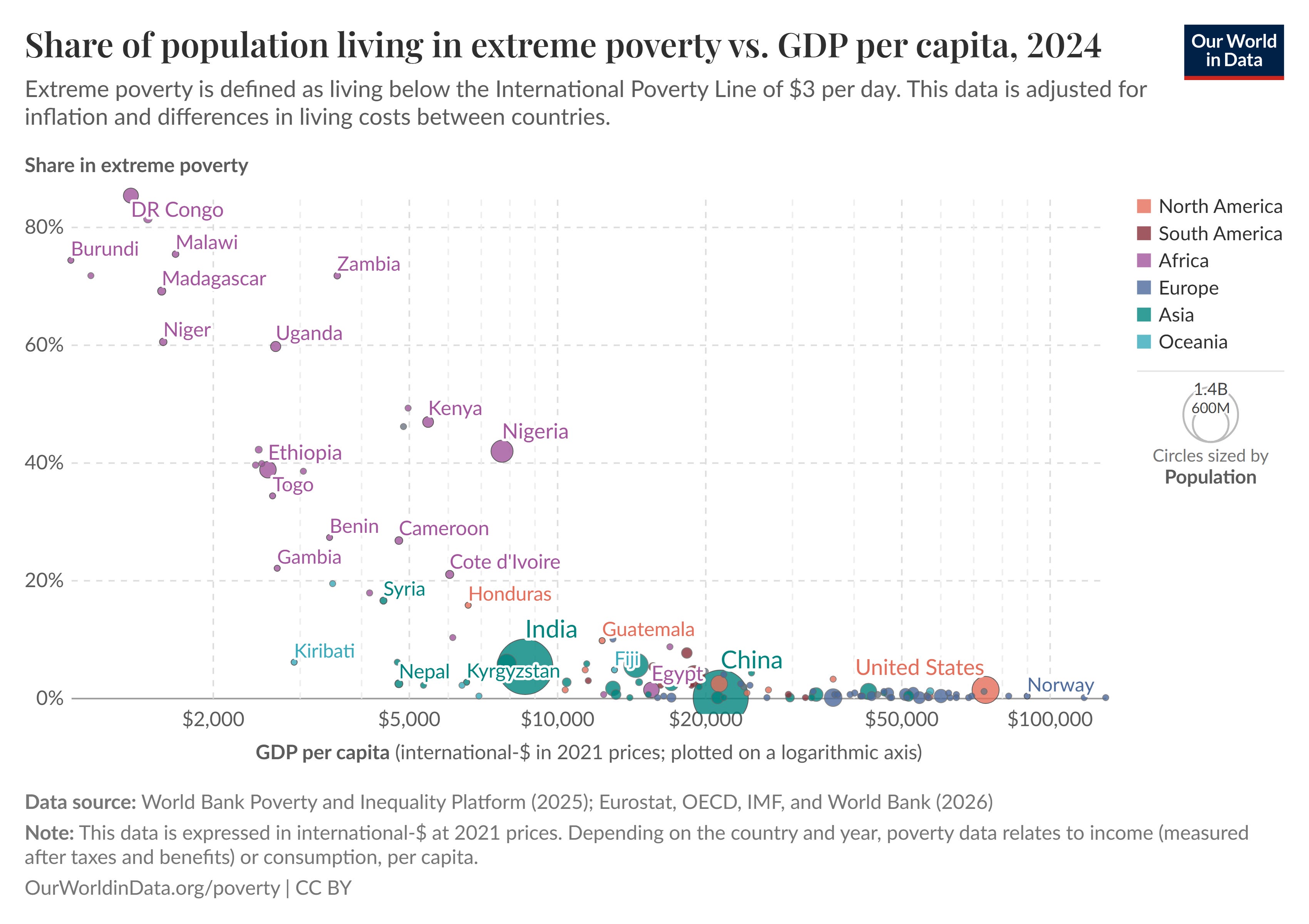
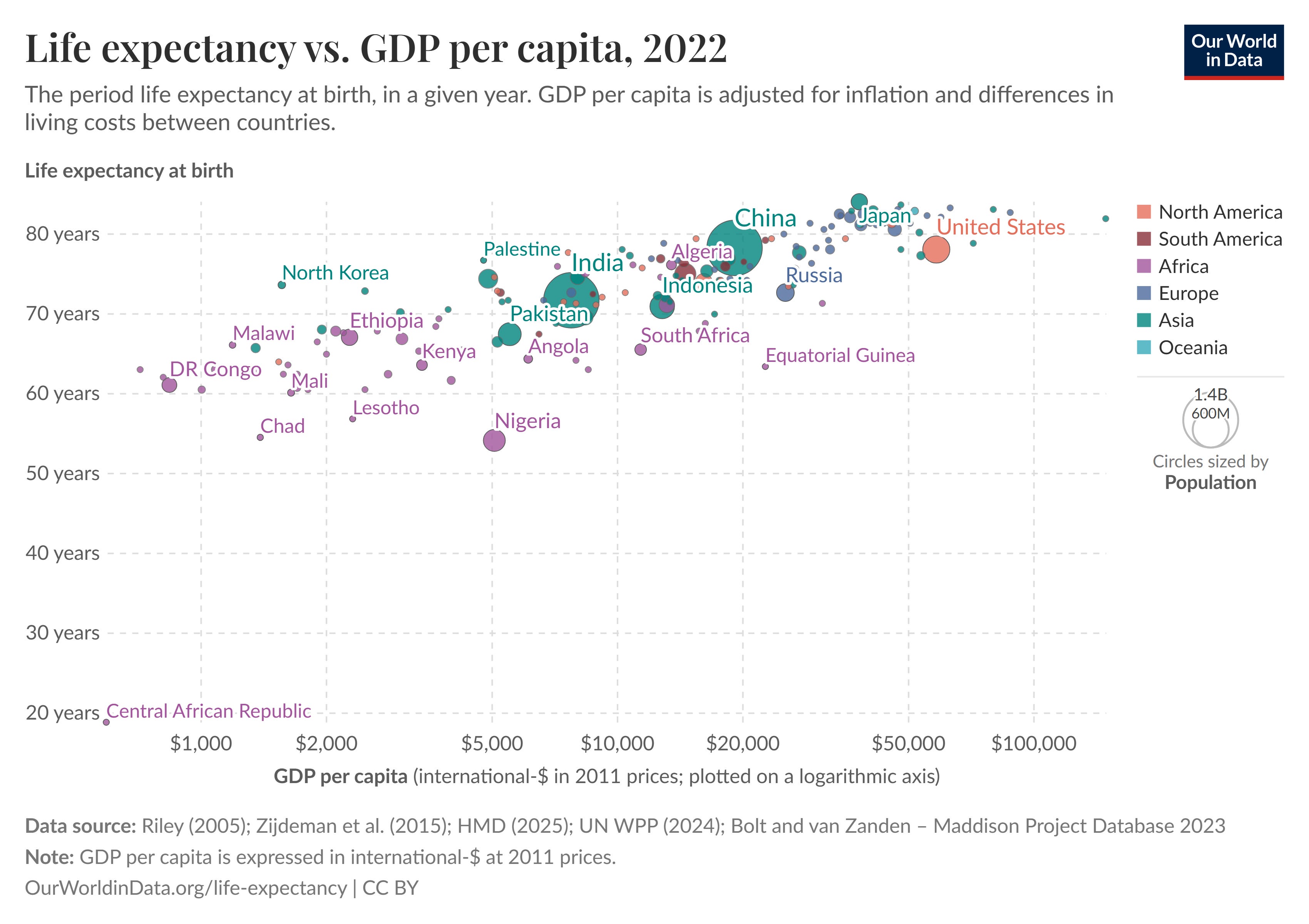
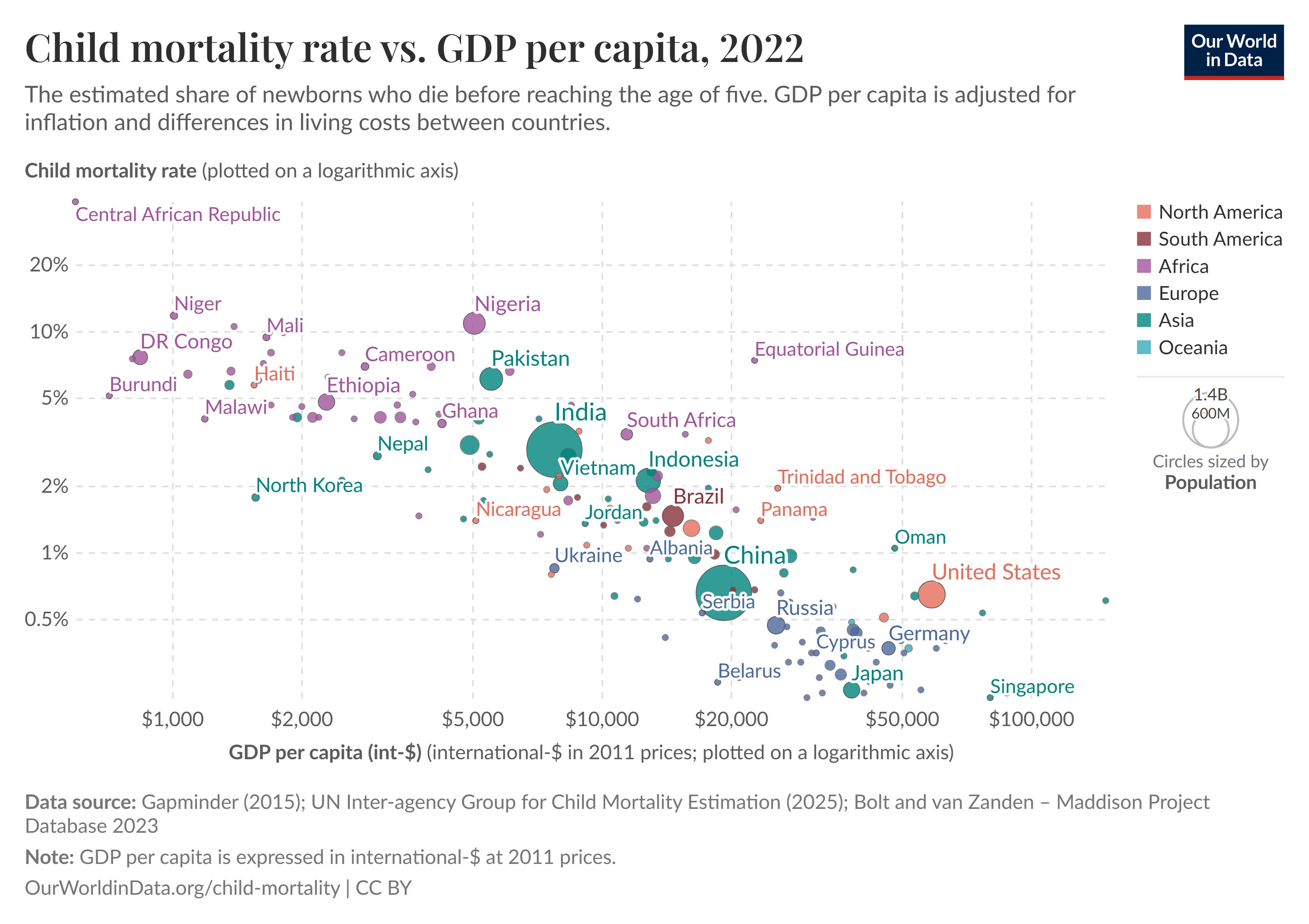
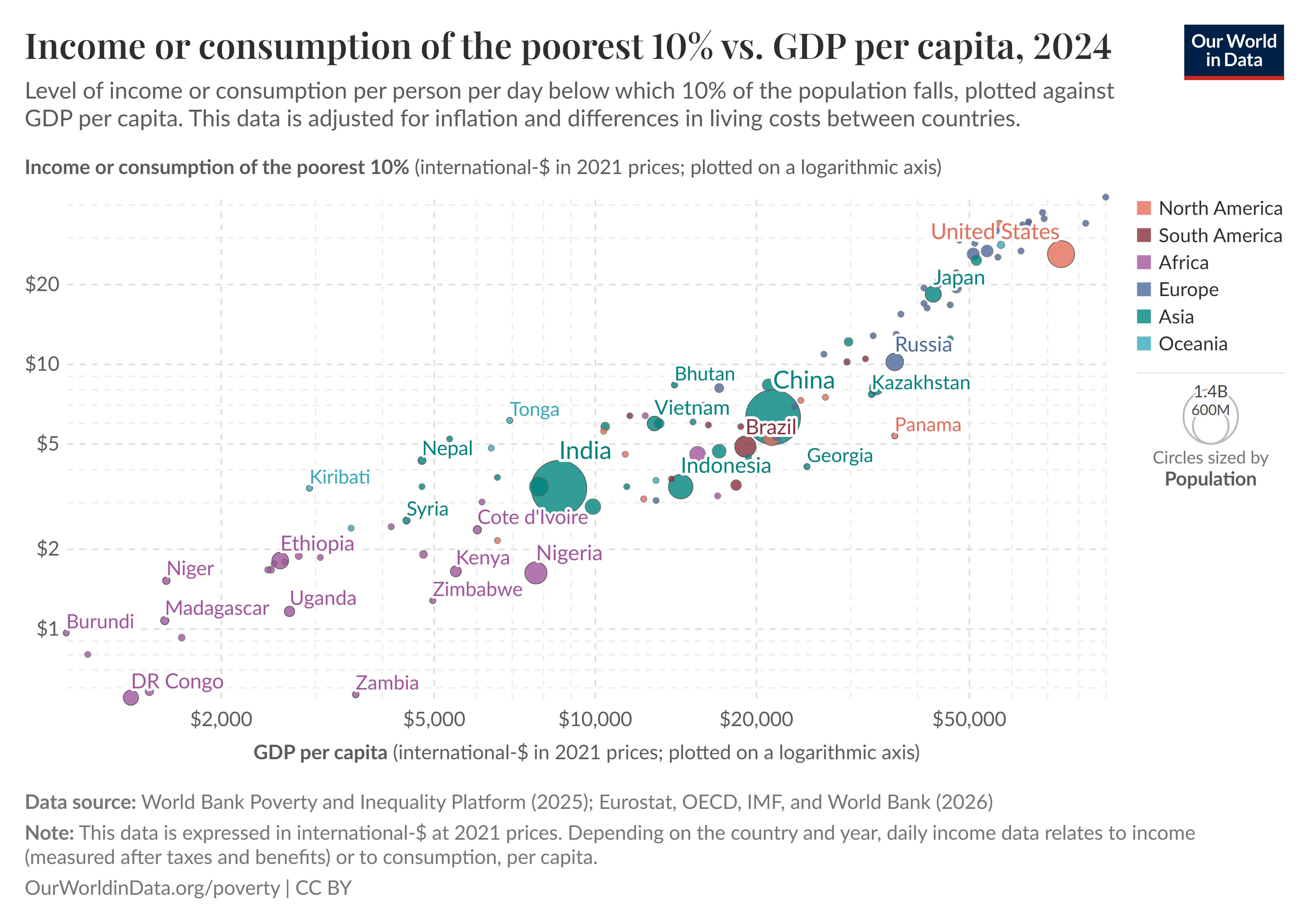
None of these correlations are very mysterious. It isn’t that GDP secretly measures all of these things. It doesn’t have to; it measures the means from which they are made, and since everyone agrees these ends matter, those means are deployed in the form of sanitation systems, insulated homes, new technology, and slack against misfortune. A society that produces more is better able, all else equal, to secure these goods.
Naturally, the same holds for goods about which people disagree. What forms of community answer to them, what art moves them, what work they find worth doing, how much they value rootedness against mobility, whether they want more leisure or more consumption, what balance of family, friendship, religion, ambition, pleasure, and solitude makes a life go well — these are not questions society can settle in advance. Often they are not even questions a person can settle in advance. They have to be tried. The utility of wealth is not only that it enables one to buy goods already known to be wanted. A richer society gives people more room to leave, return, retrain, start again, support a family, care for a parent, change work, take a risk, endure a mistake, or discover that what they thought they wanted was not, in fact, worth wanting. A society near subsistence can contain many forms of courage and beauty, but it cannot run many experiments at once, nor absorb many failures without ruin.
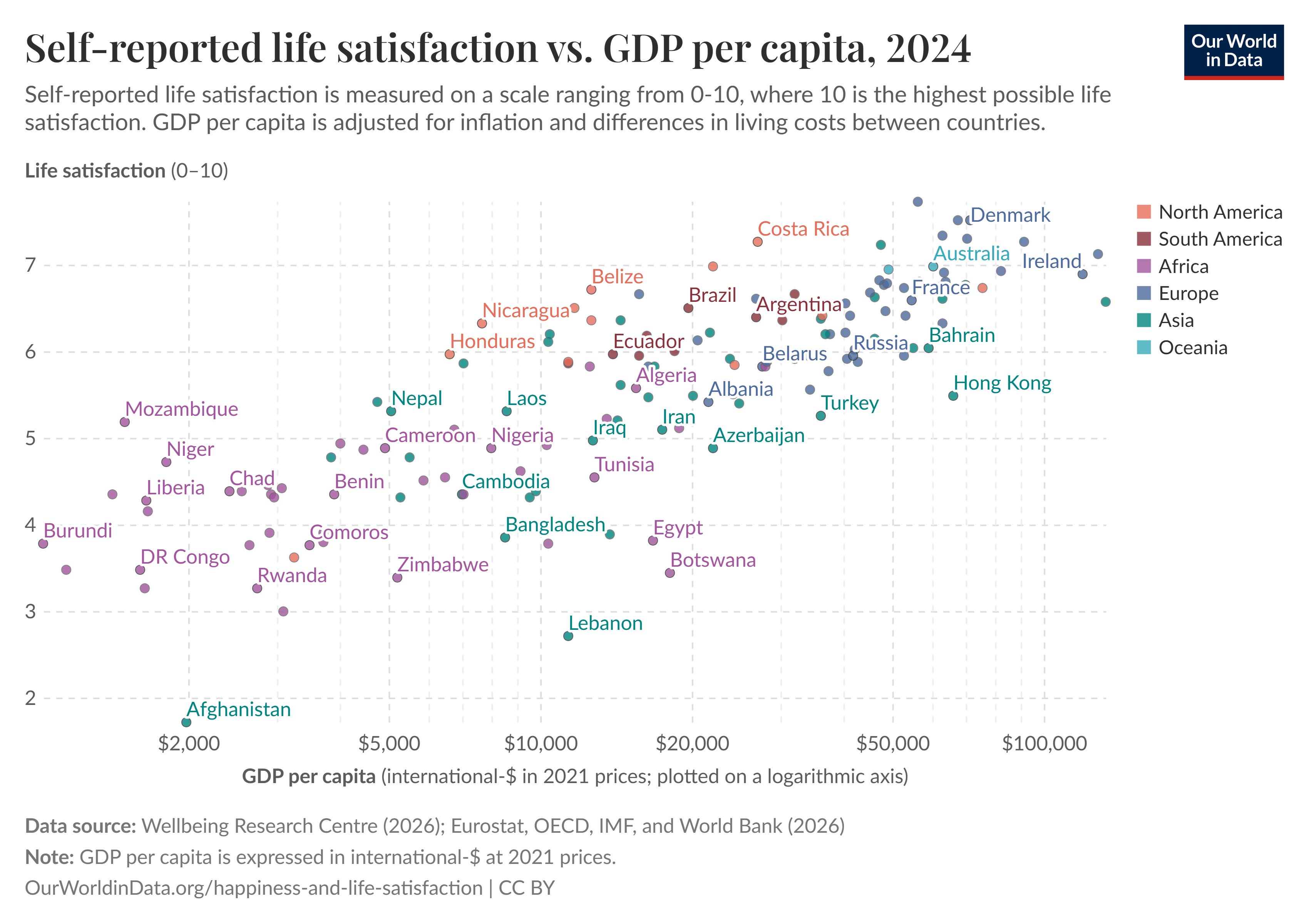
Thus if one asks the obvious question — whether people are actually happier in richer countries, at least beyond bare subsistence — the answer is yes. For a time it was thought otherwise: the Easterlin paradox held that happiness rose with income only up to some threshold, beyond which adaptation and rising expectations ate the gains. The best current evidence no longer supports this threshold. People in richer countries generally report higher life satisfaction, and richer people within countries generally do too. The relationship between income and how people rate their own lives is close to log-linear and shows no point at which it levels off, rich countries included.
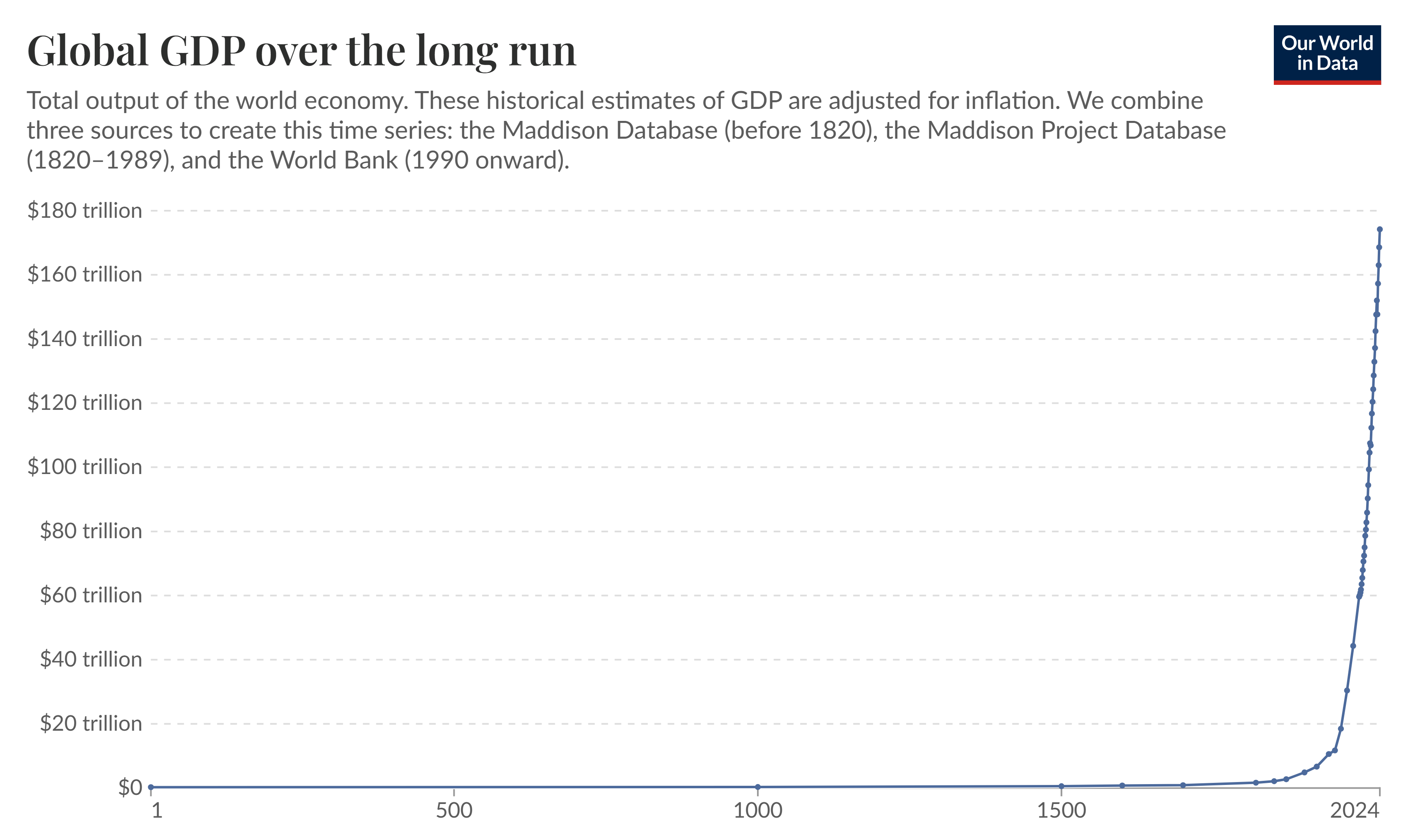
Once one sees what tends to come with higher GDP, the hockey-stick graph of world output takes on its proper significance. It is not a picture of “the economy” getting larger, as though the economy were a machine humming pointlessly in the background of human life9. It is a picture of humanity becoming vastly more capable of solving its problems. For most of history, the normal human condition was poverty, disease, darkness, hunger, child death, physical drudgery, and extreme vulnerability to bad luck. The modern growth take-off did not abolish suffering, or stupidity, or tragedy. But it changed the scale on which human beings could act against them.
Of course, it is not the case that literally everything one might care about rises with GDP. Religion seems in many places to have declined as societies have grown richer. But a richer society does have more of the slack and resources out of which religious and communal life can be sustained: free evenings, spare rooms, institutional capacity, money for buildings, and the margin for commitment. It is a separate question whether the relevant forms exist, whether people can coordinate around them, and whether people still want them as strongly once other options open up. But absent growth, we do not even find out what people would choose under conditions of abundance, nor would we have the resources to satisfy those wants at scale if we did.
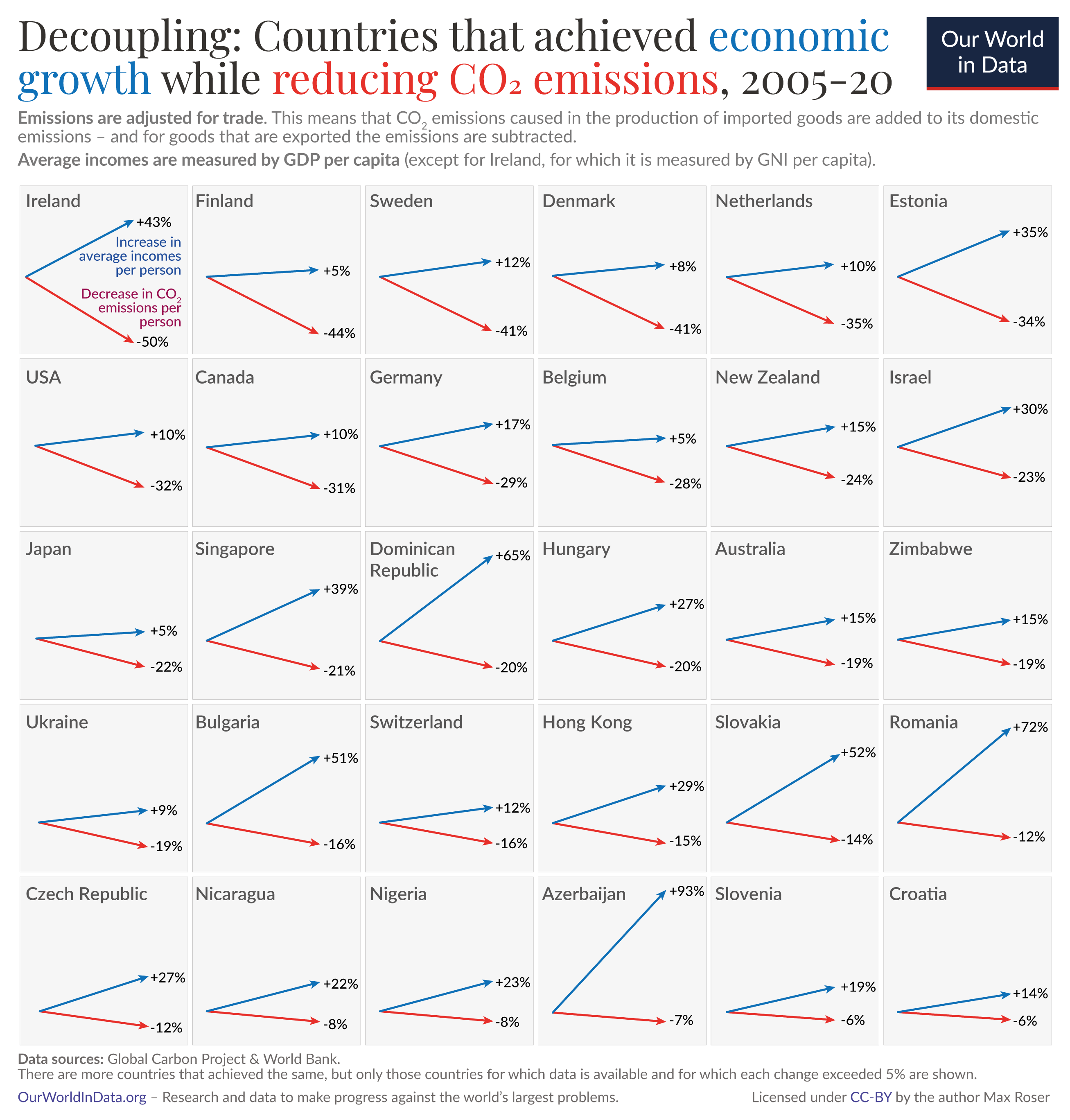
Much the same is true of climate change. At some margins, more output may indeed damage the climate: carbon emissions impose costs often not visible in the prices of the goods and services that produce them. But the liberal response to an unpriced cost is not to abandon growth, still less the exchange economy beneath it, but to bring the cost within the system of general rules — for instance, with a carbon price. Meanwhile, the relationship between output and emissions changes as countries grow richer, since a larger share of income tends to go to services rather than heavy industry: yoga classes increase GDP too. And decarbonisation itself is enormously resource-intensive, requiring scientific research, new capital stock, rebuilt grids, adaptation, and the fiscal room to absorb the costs of transition. None of this means that the “environmental Kuznets curve” has a law-like inevitability, or that growth is sufficient to solve environmental problems; political failure remains possible. But whatever a society resolves10 to do about the climate, output is what it will do it with.
VI. In The Long Run, We Are All Rich
Given that this defence of GDP trades on correlations — output per head correlating with longer lives, lower child mortality, and higher consumption among the poor — one might object that we could simply measure those things directly. And if we want a single number, why not median income? It too correlates with GDP, has a much clearer bearing on the life of a typical household, and seems to be what voters themselves care about when they keep or discard their governments. So, why privilege aggregate output over the measure closer to how people actually live?
Such considerations make sense in the short term. Over a year or an electoral cycle, median income tells us something GDP does not: how much of the flow reaches the typical household. Other measures better suit other important questions. Again, GDP does not measure how output is distributed, only the aggregate resources available.
It’s not that a liberal should be indifferent to these questions. It’s that, over the long run, GDP dominates any of these other measures, because the long run is governed by a different arithmetic: compounding. If an economy grows at 1 percent a year, then after a century, it will be 2.7 times richer. If instead it grows at 2 percent a year, it will be 7 times richer after a century; at 3 percent, 19 times richer. Differences in growth rates that look small in any given year become, over generations, the difference between civilisations. This is why Lucas could not stop thinking about growth11: over a long enough horizon, the rate of growth becomes the background condition for almost anything else a society might want to do.
Tyler Cowen12, in Stubborn Attachments, borrows from Frank Knight the image of a “Crusonia plant”: a mythical crop that keeps yielding more over time. Imagine an apple tree whose fruit supplies the seeds of more apple trees. A single harvest may be beautiful or useful. But if one plant keeps producing indefinitely, its future output becomes difficult to trade off against any benefit another plant offers only now. Economic growth matters in something like this way: other goods make claims on society’s resources; growth expands the resources those claims are made upon.
In economic terms, the point is that flows build stocks. Wealth is a stock: the assets a society has accumulated and can draw upon — houses, hospitals, laboratories, roads, machines, schools, pension funds, skills, institutions. GDP is the current flow of production and income out of which future stocks are built. Median income is a slice of that flow. Redistribution can enlarge the slice, but it cannot, by itself and indefinitely, raise the level from which the slice is cut: that takes growth. Every future stock — the hospitals and laboratories and pension funds of 2126 — has to be built out of the flow of the years between now and then. So the median is downstream of GDP; and a policy that lifts it today by shaving a few tenths off the growth rate buys a visible gain at an invisible cost. This is Bastiat’s seen and unseen, drawn out across generations: the seen is this year’s distribution; the unseen is everything the foregone growth would have made possible, invisible because it lies in the future.
So, the target is sustained growth in real GDP per capita13. Measured output this year matters only insofar as it tells us whether capacity is being expanded. A bridge to nowhere may enter the accounts; it does not make the economy more capable. A transfer may change who receives the current flow; it does not explain where future flows will come from. A society should not ask how to make the plant look larger this season. It should ask whether the plant is alive, and whether it is still growing.
The shape of the hockey stick is not mysterious: a roughly constant percentage growth rate, plotted in levels, becomes an exponential curve. What is astonishing is not the curve but the constancy — the fact that, for two centuries and counting, we have kept the process of problem-solving running and correcting long enough for the curve to bend almost vertically upward. What remains is to explain what kind of order can do that: how resources keep finding problems, how solutions keep being tried, how failures get corrected, how the flow of one year becomes the capacity of the next.
VII. Conclusion: Capacity, Not Achievement
Let’s summarise the argument. GDP is not a measure of the good, but of the means by which almost any good must be pursued: the flow of final output a society draws from scarce resources, and the problem-solving capacity that flow represents. Real GDP per capita tells us how much capacity stands behind each individual’s life; aggregate GDP, what a society can mobilise at scale. Because that flow compounds, sustained growth in real GDP per capita is the most important scalar fact about a society. That is why, I have argued, GDP is the measure a liberal should reach for first.
Of course, it is not the whole story. Kuznets, who did as much as anyone to build the national accounts, warned against confusing national income with national welfare. Capacity is not achievement. A society can command enormous means and turn them to very little; the resources can be abundant while the matching of resources to problems fails. A Crusonia plant tells you the orchard is growing; it does not by itself show how that growth connects to the particular uses people find valuable.
That is why a defence of GDP cannot stop with GDP. The statistic records the conversion of resources into solutions; it does not explain how resources find their way to the uses that matter. A scalar cannot explain how that happens in the quantity and form people actually need. Yet a resource solves nothing until it is matched to a valued use by a method that works. Moreover, a society’s means grow as more of its resources are turned to such uses. To direct resources toward the preferences people actually have, and to enlarge what they are able to do, are not two separate tasks. They are the same process seen from two sides. How does a free society solve this problem?
That is the subject of the next essay — a liberal defence of markets14.
In particular, aggregating prices does not yield a measure of social welfare. Obviously a marginal pound will usually matter more to someone with little than to someone richer. Nothing in this post turns on interpersonal comparisons of welfare; the claims throughout concern the priced value of final output: the scale of command over resources through which people pursue the ends they value.
A machine is “final” in this sense even though it exists to produce. Its opportunity cost is settled when it is built; its later contribution enters the accounts through the outputs it helps to make, and to count both the machine and its products would be the flour and the bread over again. Thus, some related measures can be seen as shifting the emphasis — for instance, subtracting replacement of worn-out capital or following ownership rather than location — to handle edge cases, but these are minor alterations to the same basic picture.
This boundary is sometimes mistaken for a denial that households produce; more specifically, a denial of the productive work often done by women. It is no such thing. Clearly a parent who buys ingredients and cooks for her children transforms inputs into something valuable; so too with care, cleaning, repair, teaching, and the maintenance of family life. But these activities belong to the subsequent conversion of available means into welfare. GDP counts the ingredients, appliances, housing services, heating, books, medicine, and other produced means made available to households; it does not then try to price every use to which households put them, or the way in which they are transformed into particular forms of life. Cooking rather than buying takeaway, or caring rather than buying childcare, does not simply make GDP smaller by the price of the service not bought: the money saved remains available for other counted goods and services. The measure is of the flow of final output made available in the common unit of account, not an all-things-considered valuation of the lives people build from it. I return later to why, for liberal purposes, this restraint is a virtue. But even if it is counted as a defect, it is not one cured by the usual alternatives: median income, life expectancy, schooling, happiness, and composite indices either leave much of the household conversion of means into welfare outside the measure, as GDP does openly, or import contestable weights for valuing it.
For many non-market public services, the accounts cannot observe a buyer’s willingness to pay, and so must use some combination of input costs, activity measures, and output indicators. Since the Atkinson Review, British statisticians have tried to measure parts of public-service output directly — for example, pupils taught, operations performed, or quality-adjusted services delivered — rather than treating spending as output. But the underlying difficulty remains: the accounts can record resources committed, and sometimes services measurably delivered, without thereby settling whether the commitment was wise. Government output is therefore best read as an attempt, sometimes successful and sometimes not, to solve problems on the public’s behalf. These commitments still belong in GDP, as they are part of the means a society brings to bear on its problems. But is the democratic accountability mechanism a robust way to enlarge those means over time, and enhance welfare? That is a separate institutional question, to which we will return later.
However, nominal GDP is important for a different problem — macroeconomic stability — to which we will return in a later piece.
This specific version is from here, and got a laugh from Elon Musk, of all people. He apparently enjoyed it so much that he told it to Joe Rogan (2:27:01). But I couldn’t find its origin. The earliest English version GPT-5.5 could find, from 2005, is here, though it also finds a Chinese version here from 2004.
A requirement of the European System of Accounts (2010), which the ONS implemented in 2014, adding roughly £10 billion a year to measured output; comparability requires that countries whose laws differ be measured on the same production boundary.
As in the previous piece, neutrality here means neutrality among ends, not neutrality among every institutional fact about the economy. GDP records final output at the money values assigned to it — by market prices, imputations, or public-sector costs — and therefore inherits the distribution of claims and the institutional arrangements that produced those values. It does not ask whether purchasing power is fairly distributed, whether some preferences command too many resources, or whether the process that generated the output is itself defensible. Questions about inequality, and the distribution and organisation of production, will be addressed in a later piece. Here, I am making the much narrower point that GDP does not rank the ends for which output is used.
As Ariele has put it:
there’s a lot of people who think there’s “gdp factories” that only produce “gdp” instead of goods and services we want to buy
And of course, if people are richer, if they are no longer preoccupied with subsistence, then they have more room to care about and act on environmental concerns.
Here’s the full paragraph quoted in the epigraph. Can you sense his urgency?
I do not see how one can look at figures like these without seeing them as representing possibilities. Is there some action a government of India could take that would lead the Indian economy to grow like Indonesia's or Egypt's? If so, what, exactly? If not, what is it about the 'nature of India' that makes it so? The consequences for human welfare involved in questions like these are simply staggering: Once one starts to think about them, it is hard to think about anything else.
Cowen and I discuss his book, and growth, at some length in my interview with him here:

In some sense, this means treating GDP as a yardstick rather than a target. Goodhart’s Law warns us that when a measure becomes a target, it deteriorates as a measure; governments instructed to maximise this year’s GDP can always find ways to move the statistic while damaging the underlying capacity it is meant to track. Hence, the claim here is instead about sustained growth in real productive capacity, for which GDP is the best scalar proxy.
Which, if you’re reading this, doesn’t exist yet. Watch this space!
this is excellent … worth pointing out how a similar argument with neutrality can be made for cost benefit analysis (as made by heath)